
The Problem That Started All of This
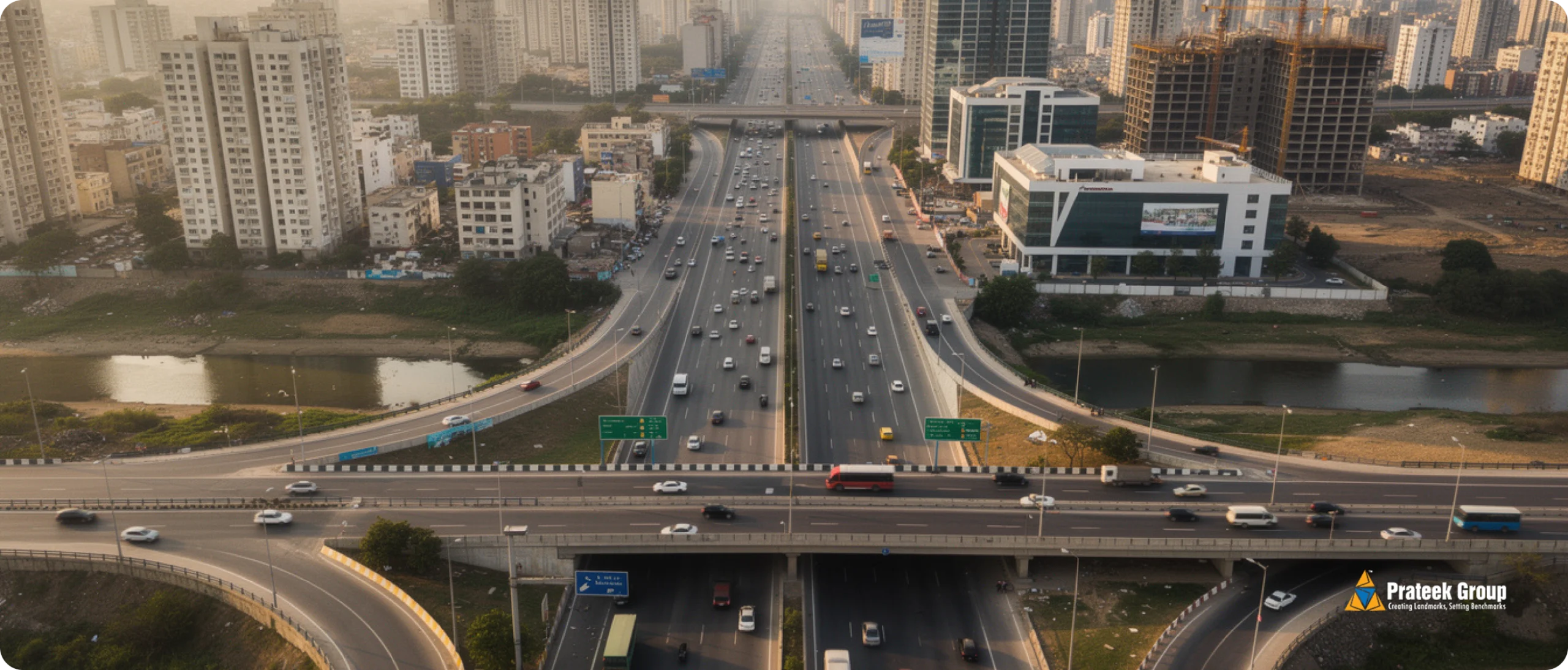
The Noida-Greater Noida Expressway carries roughly 10 lakh vehicles every day. It is the only major road connecting Noida to Greater Noida, the Yamuna Expressway, and the upcoming Noida International Airport at Jewar. That single corridor has been under growing strain for years, and there is no realistic alternative route at present.
The Noida International Airport, inaugurated on March 28, 2026 by Prime Minister Narendra Modi, is designed to handle up to 225 million passengers annually at full capacity. According to a Square Yards report titled Runway to Realty, this airport is expected to double transportation volume through Noida and Greater Noida. The expressway, already running close to capacity during peak hours, simply cannot absorb that kind of increase without a parallel route.
That is the background behind two connected infrastructure projects now in motion: the widening and upgrade of the Yamuna Pushta Road into an 8 to 10 lane corridor, and the construction of the Chilla Elevated Road linking Delhi directly into this new network.
What Is Actually Being Built
1. The Yamuna Pushta Road Upgrade (Sector 94 to Sector 150)
The Yamuna Pushta Road currently runs along the Yamuna embankment from Sector 94 to Sector 150 in Noida. The road exists today, but in poor condition. Sections are damaged, with deep potholes and narrow stretches that make it unsuitable for high-volume traffic.
Noida Authority CEO Krishna Karunesh confirmed that this road will be redeveloped into an 8 to 10 lane facility. The initial phase will be six lanes, with space reserved for future expansion. The Noida Authority, Greater Noida Authority, and Yamuna Authority will share the construction costs.
Alongside this, a 31.2 km elevated corridor is proposed. It would run from Okhla Barrage near Sector 94, follow the Yamuna embankment, cross the Hindon River, and connect to the Yamuna Expressway near Gharbara village (opposite Gautam Buddha University). The corridor would be six lanes and pass through Sectors 95, 125, 126, 127, 128, 129, 130, 131, 132, 133, 134, and 135. These sectors contain offices, institutions, and residential complexes, meaning the corridor has a ready base of daily users.
A consulting firm, Almondz Global Infra (appointed by UPEIDA), has already begun surveying the route. The detailed project report is expected within three months. Construction, once approved, is projected to take about two years.
2. The Chilla Elevated Road (Delhi to Noida)
The Chilla Elevated Road is a 5.9 km, six-lane structure connecting the Chilla Regulator in Delhi to the area near Mahamaya Flyover in Noida. It is being built by the Uttar Pradesh Bridge Corporation at a cost of Rs 892 crore. Construction began in early 2025.
Once complete, this road will allow vehicles coming from Mayur Vihar and Akshardham in Delhi to reach the Noida-Greater Noida Expressway without passing through the congested Film City and Sector 18 stretches. The road effectively creates a bypass for Delhi-bound traffic entering Noida.
3. The Mahamaya Interchange (Connecting Both Roads)
The third piece is a 1.8 km cloverleaf interchange near the Mahamaya Flyover. This interchange, modelled after the one near AIIMS in Delhi, will connect three traffic streams: vehicles from Mayur Vihar (via the Chilla Elevated Road), vehicles from Kalindi Kunj, and vehicles from the Mahamaya Flyover. All three streams will merge into the Yamuna Pushta corridor and the expressway network near Sector 94.
Vijay Kumar Rawal, DGM (Civil) at Noida Authority, stated that once these elevated roads are connected, vehicles heading to Agra, Lucknow, or Noida International Airport will no longer need the Noida-Greater Noida Expressway at all. That single statement captures the scale of what this project is designed to do.
The Project at a Glance
| Component | Details |
|---|---|
| Yamuna Pushta Road | Sector 94 to Sector 150; 8–10 lanes; 31.2 km elevated corridor proposed |
| Chilla Elevated Road | 5.9 km; 6 lanes; Rs 892 crore; connects Delhi (Chilla) to Mahamaya Flyover |
| Mahamaya Interchange | 1.8 km cloverleaf; connects Mayur Vihar, Kalindi Kunj, Mahamaya traffic |
| Consultant | Almondz Global Infra (appointed by UPEIDA) |
| DPR Timeline | 3 months from survey completion |
| Est. Construction Period | Approximately 2 years |
| Cost Sharing | Noida Authority, Greater Noida Authority, Yamuna Authority |
Why This Matters for Noida's Real Estate Market
Infrastructure and property prices in Noida have moved in tandem for the past five years. The data is specific. According to ANAROCK, average residential prices in Noida stood at approximately Rs 4,795 per sq ft in 2020. By Q1 2025, that number had climbed to Rs 9,200 per sq ft. That is roughly a 92% increase in five years, and most of that appreciation tracks directly to infrastructure announcements and construction milestones: the Jewar airport, the Yamuna Expressway upgrades, metro extensions, and expressway widenings.
The Square Yards Runway to Realty report goes further. It records that apartment prices along the Yamuna Expressway corridor have nearly tripled between 2020 and 2025. Plot values rose 1.5x on average, with select micro-markets seeing up to 5x growth. Average plot prices moved from roughly Rs 1,100 per sq ft in 2020 to nearly Rs 3,000 per sq ft by 2025.
The report projects that apartment values will rise another 22% and plot values another 28% over the next two years. Noida-wide, new launch prices are projected to reach Rs 18,000 to Rs 22,000 per sq ft by 2027, up from Rs 14,946 per sq ft in 2024.
What the Pushta Road Specifically Changes
The Yamuna Pushta Road runs through the heart of Noida’s mid-sector belt. Sectors 125 through 135 are home to offices, schools, hospitals, and a growing number of residential projects. Until now, these sectors have relied on internal roads and feeder connections to the expressway. Direct access to a 10-lane corridor changes their position in the connectivity hierarchy entirely.
Sector 150, where the Pushta Road terminates and connects to both the Yamuna Expressway and the Noida-Greater Noida Expressway, is already one of the fastest appreciating micro-markets in Noida. Property prices there have risen approximately 100% since 2019, with the current rate reaching about Rs 14,274 per sq ft. The sector’s development plan allocates 80% of land to greenery and 70% to sports amenities, which makes it distinct from the denser central Noida sectors. Prateek Group’s Prateek Canary in Sector 150 sits in this growth corridor.
The logic is straightforward. When a new arterial road provides a faster, less congested alternative route from Delhi to the Yamuna Expressway and the airport, every sector along that route becomes more accessible. More accessibility means shorter commute times. Shorter commute times attract buyers. Buyers increase demand. Demand moves prices.
The Chilla Connector and Its Effect on Central Noida
The Chilla Elevated Road matters most for central Noida sectors like 45, 61, 77, and 120, where most of Noida’s existing residential stock is located. These sectors currently suffer from traffic bottlenecks at the Delhi-Noida border, particularly during morning and evening peak hours. The elevated road bypasses that chokepoint entirely.
For projects like Prateek Stylome in Sector 45, Prateek Fedora in Sector 61, Prateek Wisteria in Sector 77, and Prateek Laurel in Sector 120, the Chilla connector shortens the effective distance to Delhi by several kilometres of stop-and-go traffic. The National Housing Bank’s data shows that properties within 1 km of major transit corridors in Delhi NCR command 10 to 30% higher prices than those 2 to 3 km away. The Chilla Elevated Road puts these central Noida sectors squarely within a fast-access corridor to Delhi.
The Jewar Airport Connection
The Noida International Airport at Jewar is the reason all of this is happening on an accelerated timeline. The airport, spread across 5,000 hectares with an estimated cost of Rs 30,000 crore, was inaugurated on March 28, 2026. Commercial flights are expected to begin within 45 days of inauguration.
Ankita Sood, National Director of Research at Knight Frank India, added a note of caution: much of the current price growth is sentiment-driven and based on expectations rather than ground reality. Soft infrastructure like schools, hospitals, and employment centres will take time to develop, and sustainable appreciation will depend on economic anchors such as industries and service-sector employers setting up in the region.
That caution is worth taking seriously. But the Pushta Road and Chilla connector are not speculative. Construction contracts have been awarded. Survey teams are on the ground. Budget allocations have been made by three separate authorities. These are real projects with defined timelines, and their completion will close the connectivity gap between Delhi, Noida, and the airport in a measurable way.
Sectors to Watch Along the Corridor
Sector 94: The starting point of the Pushta Road and the location of the Mahamaya interchange. This sector already benefits from proximity to the Noida Expressway and the Okhla Bird Sanctuary. The new interchange will make it a primary junction for all Delhi-bound and airport-bound traffic.
Sectors 125 to 135: These mid-belt sectors along the elevated corridor will gain direct expressway access for the first time. Office parks, residential societies, and institutions in these sectors currently depend on congested internal roads. The elevated road changes that.
Sector 150: Already the fastest growing residential sector in Noida, with prices doubling since 2019. The Pushta Road terminates here, linking it to both the Yamuna Expressway and the Noida-Greater Noida Expressway. Projects in Sector 150 like Prateek Canary benefit from this dual connectivity.
Sectors 45, 61, 77, 120: Central Noida sectors that will see reduced travel times to Delhi once the Chilla Elevated Road is complete. These are mature residential markets with established amenities, schools, hospitals, and commercial centres. Reduced congestion at the Delhi border improves liveability, which supports both rental demand and resale values.
What This Means for Homebuyers in 2026

The data from the past five years tells a clear story. Unsold inventory in Noida dropped 72% between Q1 2020 and Q1 2025, according to ANAROCK. Delhi-NCR led luxury home launches in the first half of 2024, with 26% of 23,500 units priced above Rs 5 crore. The market has moved from a buyer’s market with excess supply to a seller’s market with constrained inventory and rising prices.
For someone buying a home in Noida today, the Pushta Road and Chilla connector are relevant for two reasons. First, they will materially reduce commute times. A resident of Sector 150 heading to Delhi currently has one realistic route: the Noida-Greater Noida Expressway to the DND or Kalindi Kunj. The Pushta Road offers a second, parallel route with direct access to the Mahamaya interchange and from there to Delhi via the Chilla corridor. That second option, by itself, reduces peak-hour travel time and provides a fallback when the expressway is congested.
Second, these roads are being built before the full impact of the airport traffic hits. The Noida Authority is building the parallel corridor proactively, which means buyers in the catchment area are purchasing at prices that do not yet fully reflect the completed infrastructure. Historically in NCR, the largest price jumps happen between project announcement and completion, with a secondary bump after the road is operational and traffic patterns stabilize.
If you are evaluating properties in Noida, understanding the specific route of these projects and where your prospective home sits relative to them is worth the effort. Prateek Group’s projects across Noida are positioned in several of the sectors that stand to benefit directly from this new corridor.
The Broader Infrastructure Picture
The Pushta Road and Chilla connector do not exist in isolation. They are part of a wider set of infrastructure additions in the region:
The Faridabad-Noida-Ghaziabad (FNG) Expressway is 70% complete and expected to be operational by 2028. Over 1 lakh people travel daily between Faridabad, Ghaziabad, and Noida, and this expressway will provide the first direct road link between Faridabad and Uttar Pradesh, bypassing Delhi entirely.
The Ghaziabad-Jewar RRTS is expected by 2027, which will reduce travel time from Delhi to the airport region and support transit-oriented development in sectors along its route.
Metro extensions into Greater Noida and the Yamuna Expressway corridor are planned, adding rail connectivity to areas that currently depend entirely on road access.
The Delhi-Mumbai Expressway, once fully complete, connects to the Eastern Peripheral Expressway, which links to the Yamuna Expressway. This chain of expressways positions Noida at the intersection of multiple national corridors. Understanding how urban infrastructure reshapes property prices in Delhi NCR helps put these individual projects in context.
Where Things Stand Now
The Chilla Elevated Road is under construction. The Yamuna Pushta Road survey is underway. The Mahamaya interchange design process is about to begin. These three components, working together, will create a second arterial route between Delhi and the Yamuna Expressway, parallel to the existing Noida-Greater Noida Expressway.
The timeline is two to three years for full completion. The budget is shared across three authorities. The consultant is on site. There is nothing speculative about any of this; the projects have moved past the announcement phase and into execution.
For the 10 lakh people who use the Noida-Greater Noida Expressway every day, this is the most significant road infrastructure addition in the region in over a decade. For homebuyers and property investors, the corridor map of the Pushta Road is worth studying carefully. The sectors it passes through, and the sectors it connects at each end, are the areas where connectivity will change most over the next 24 months.